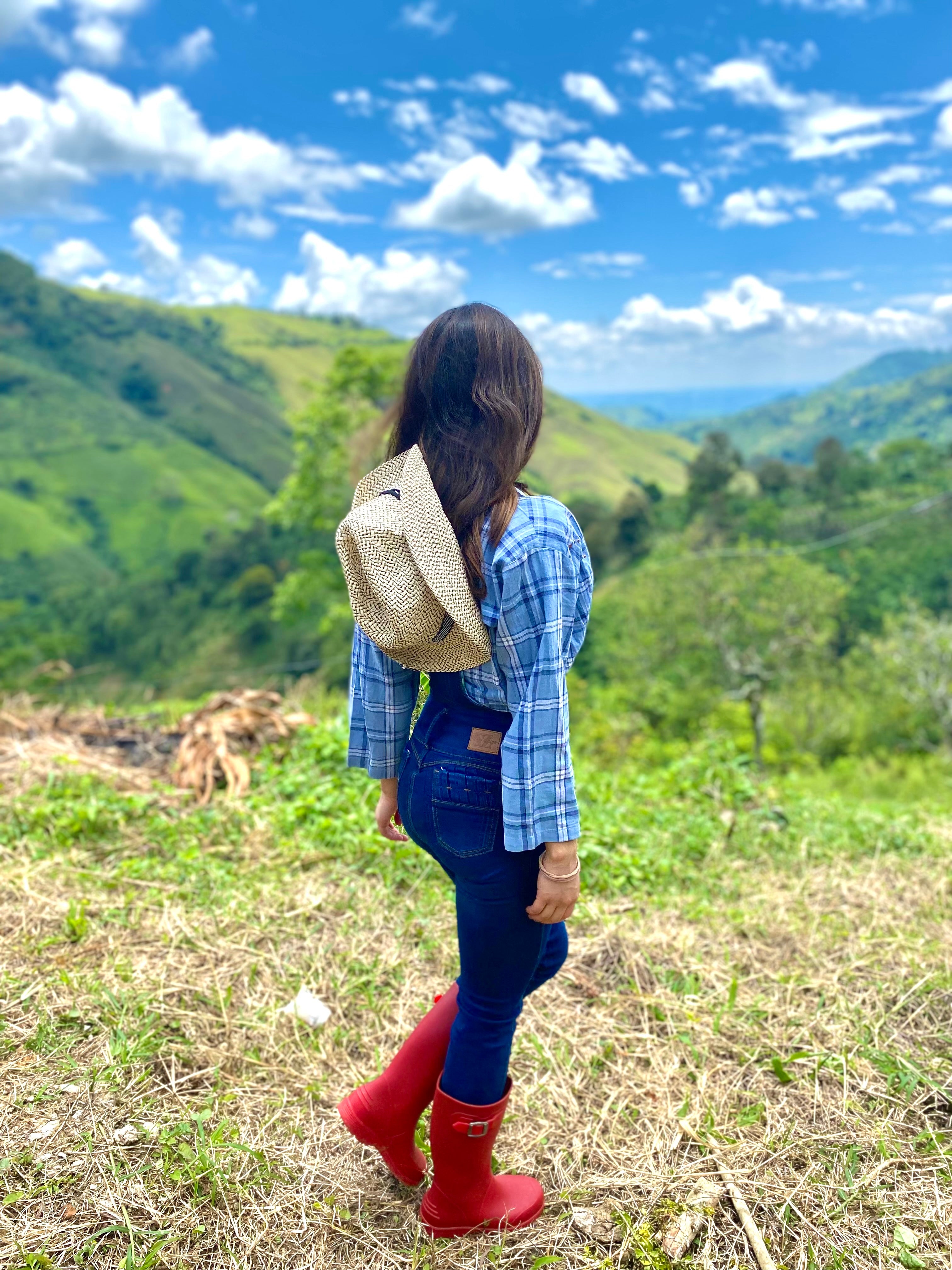



Welttisch: Jetzt auch als Geschenk für eine kuschelige Zeit
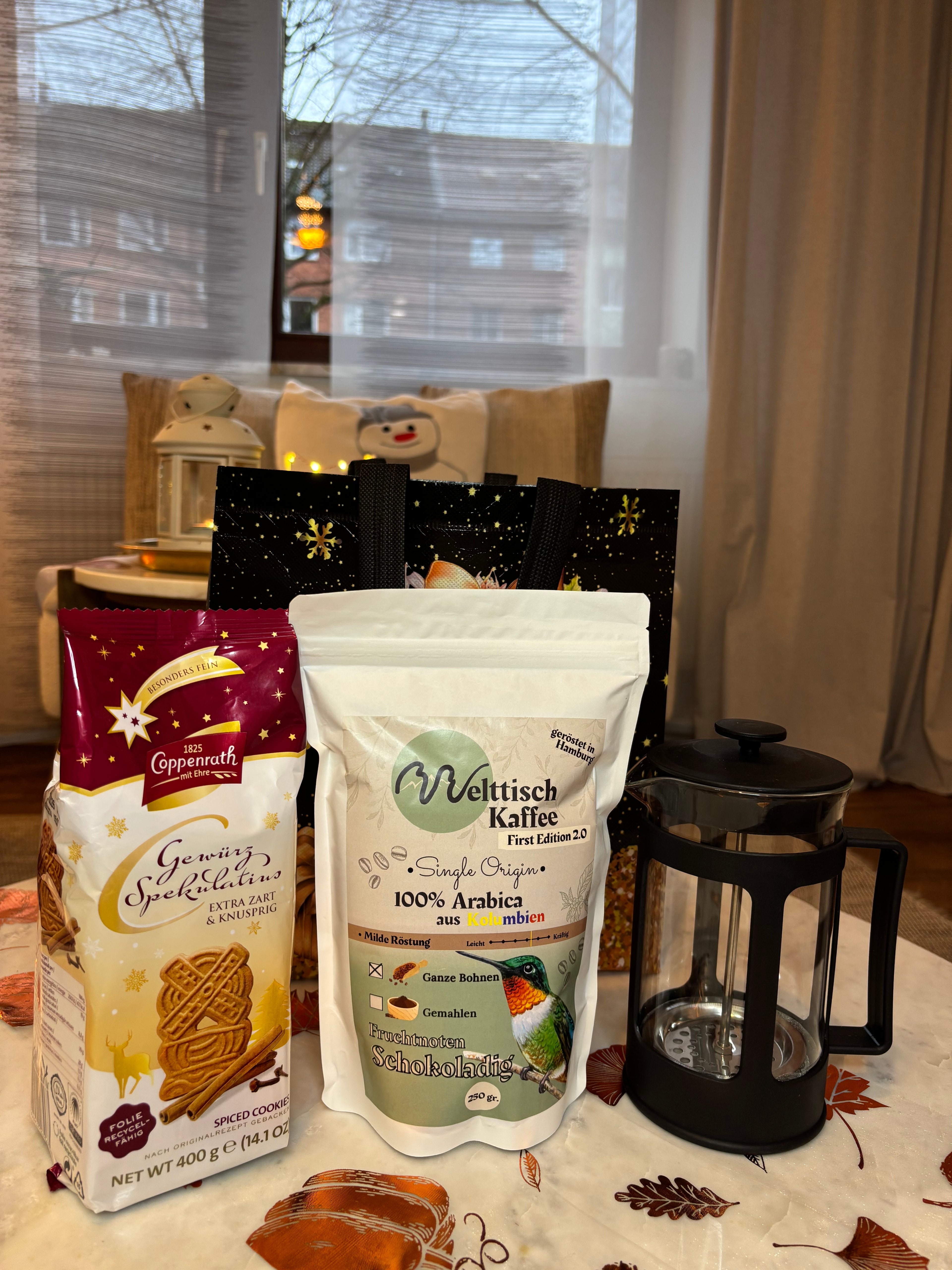
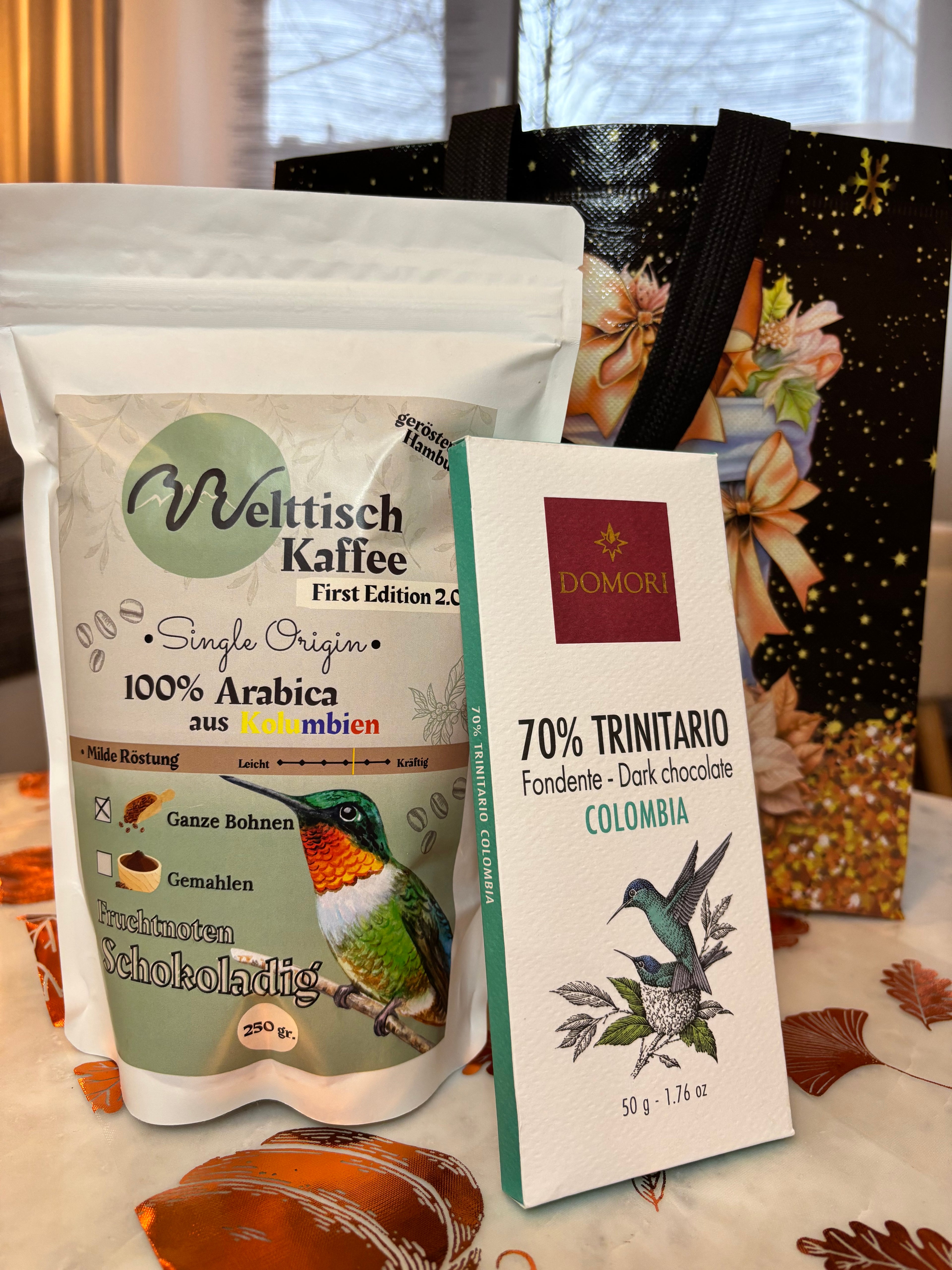
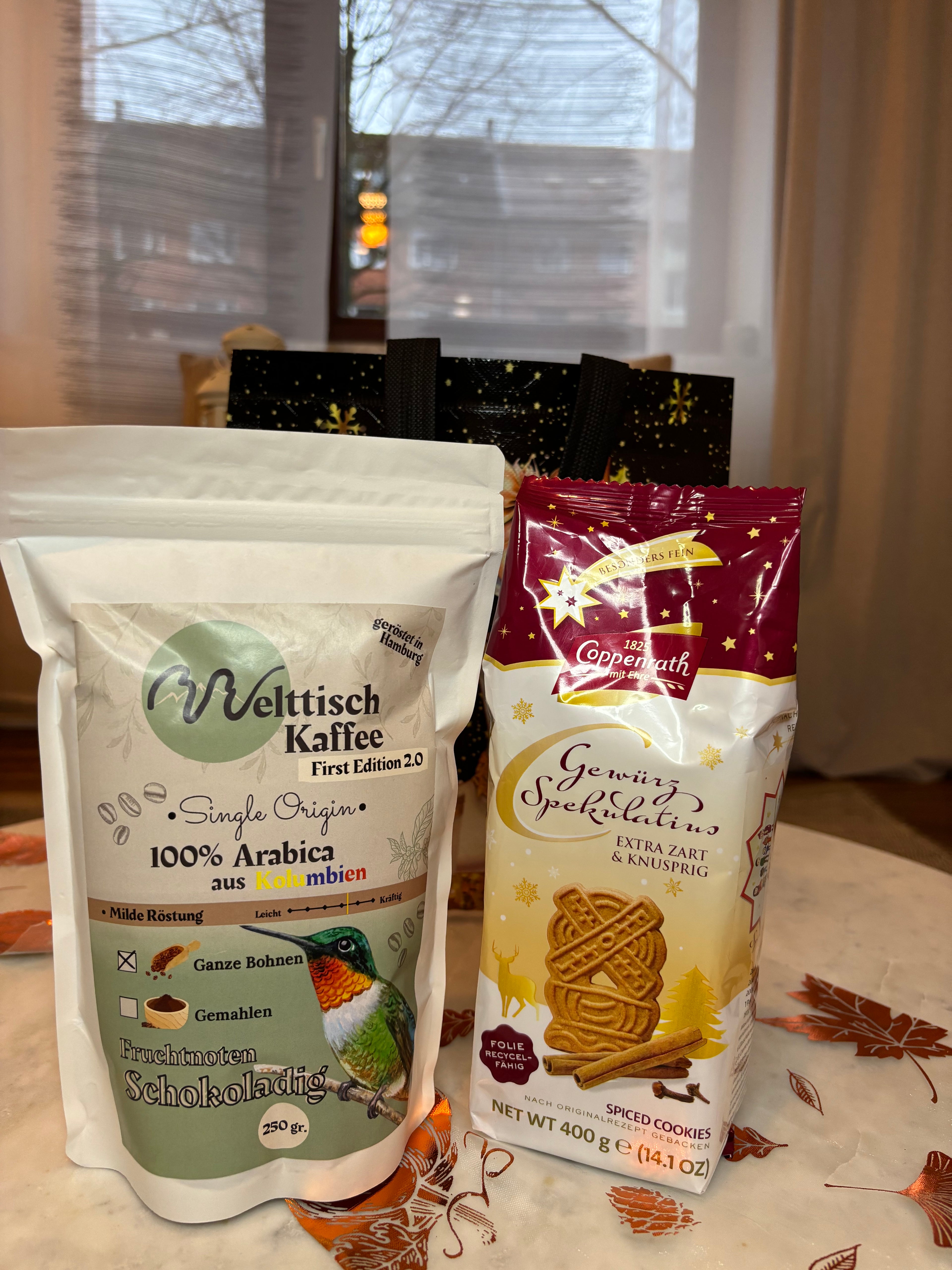
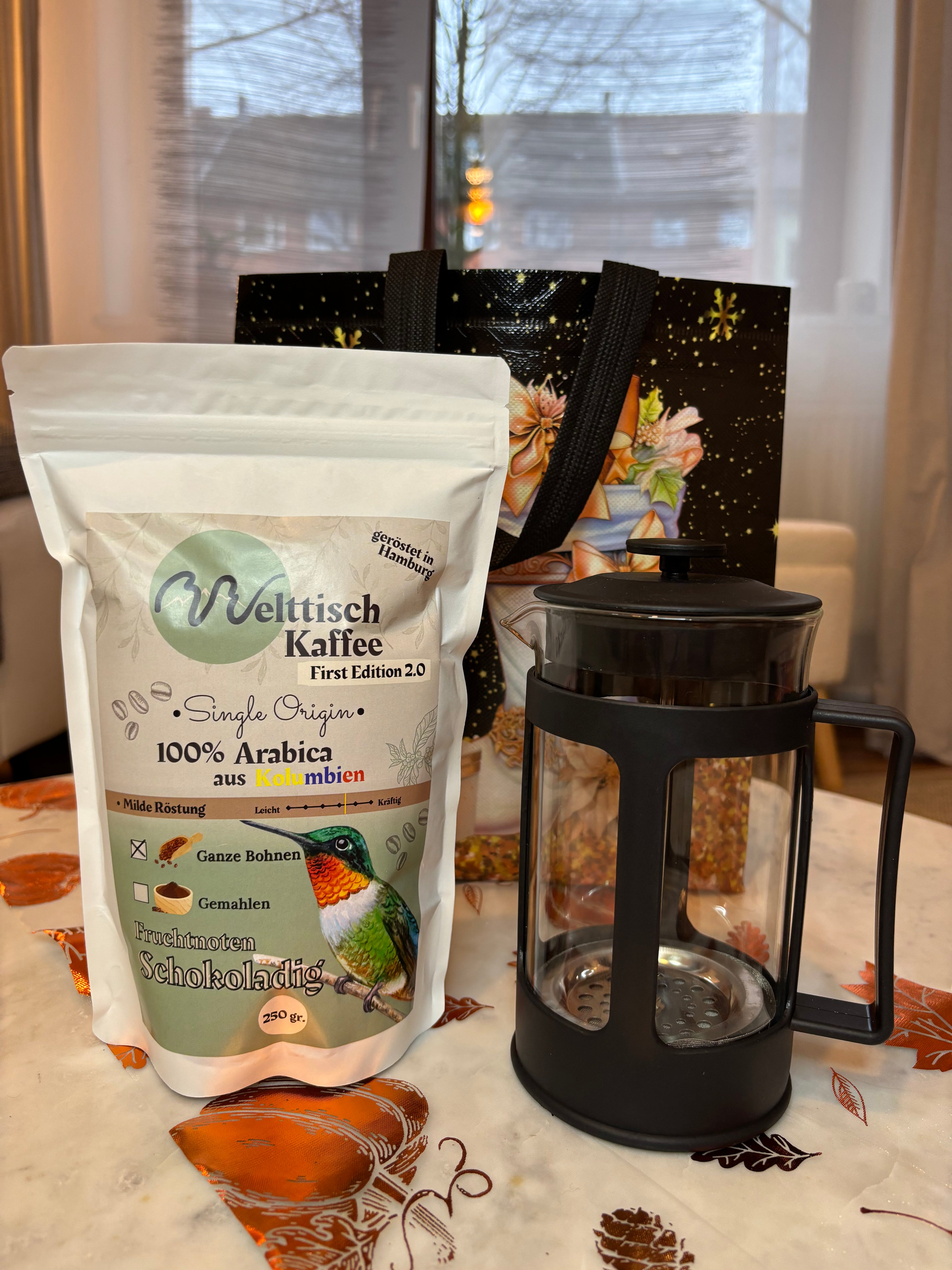
Weihnachts Geschenkbox: Cozy Kaffeezeit
- Regular price
-
$64.000,00 - Regular price
-
$64.000,00 - Sale price
-
$64.000,00
nur für kurze Zeit: Versand gratis schon ab 31 € Bestellwert!
Als Kleinunternehmer im Sinne von § 19 Abs. 1 UStG wird keine Umsatzsteuer berechnet.
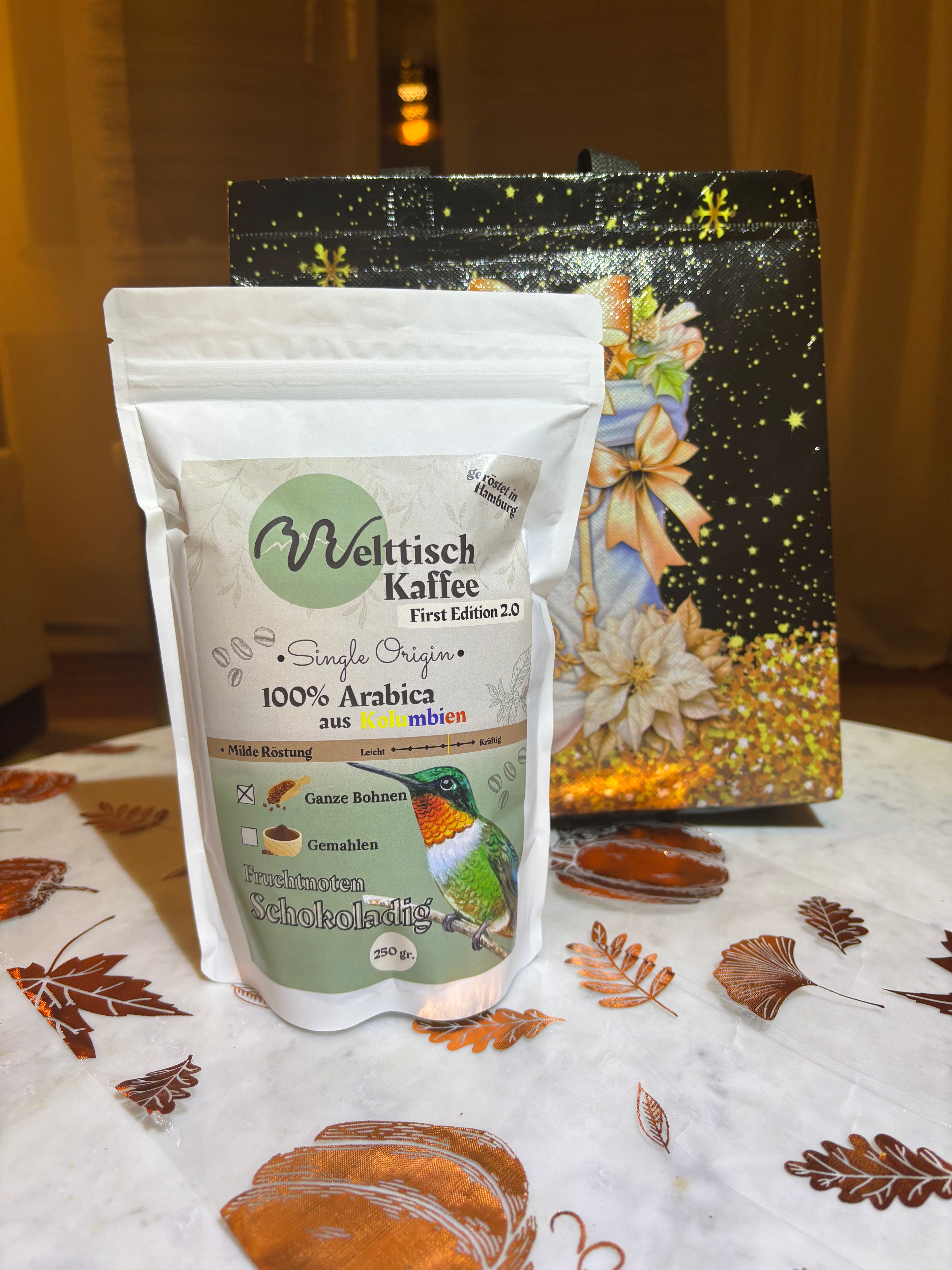
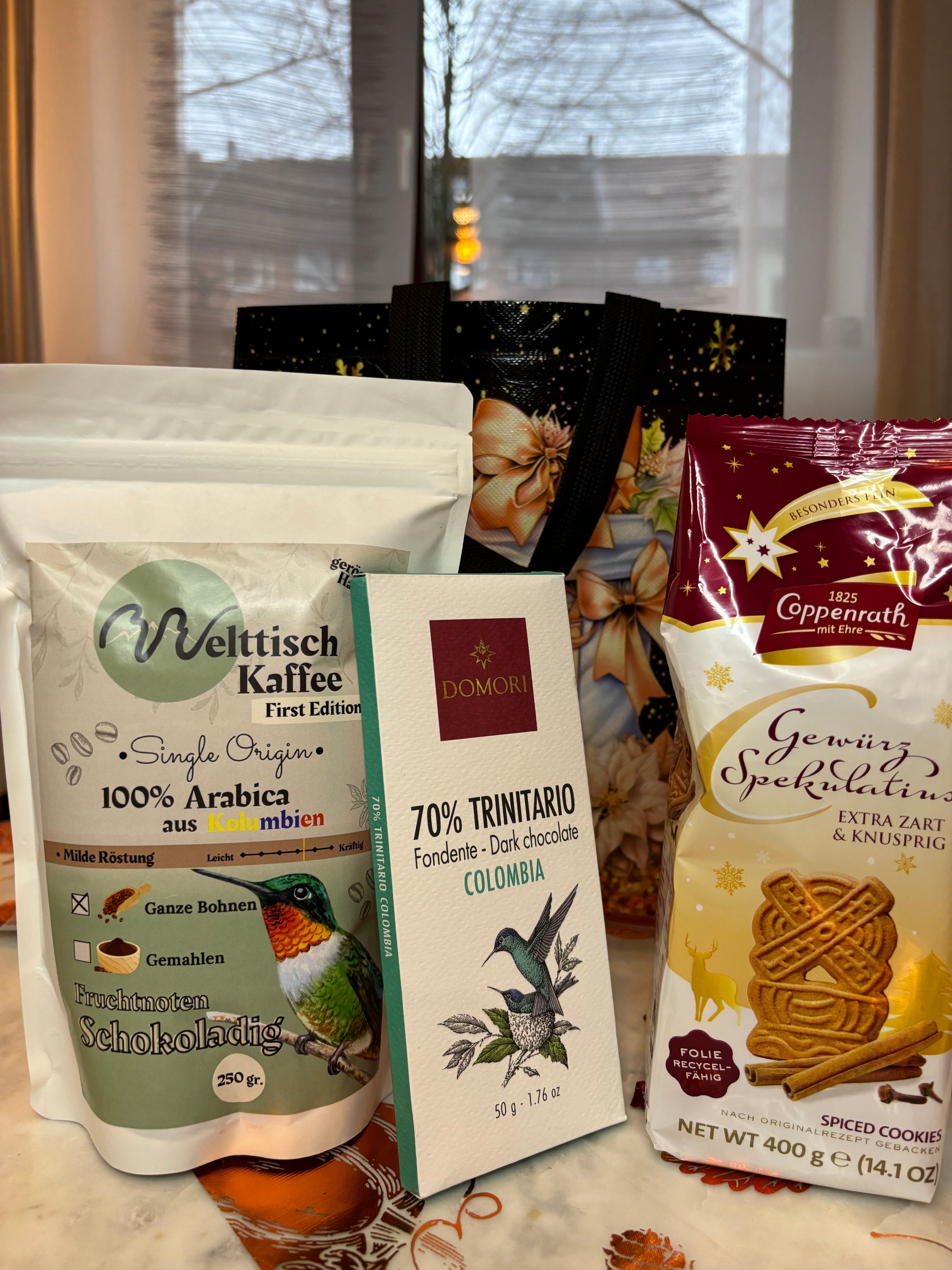
Versüße dir und deinen Liebsten die dunkle Jahreszeit mit einem Geschenk zum gemütlich machen und genießen! Bester kolumbianischer Kaffee und Schnuckerkram nach Wahl. Kekse? Schokolade? Oder einfach beides? Du entscheidest!
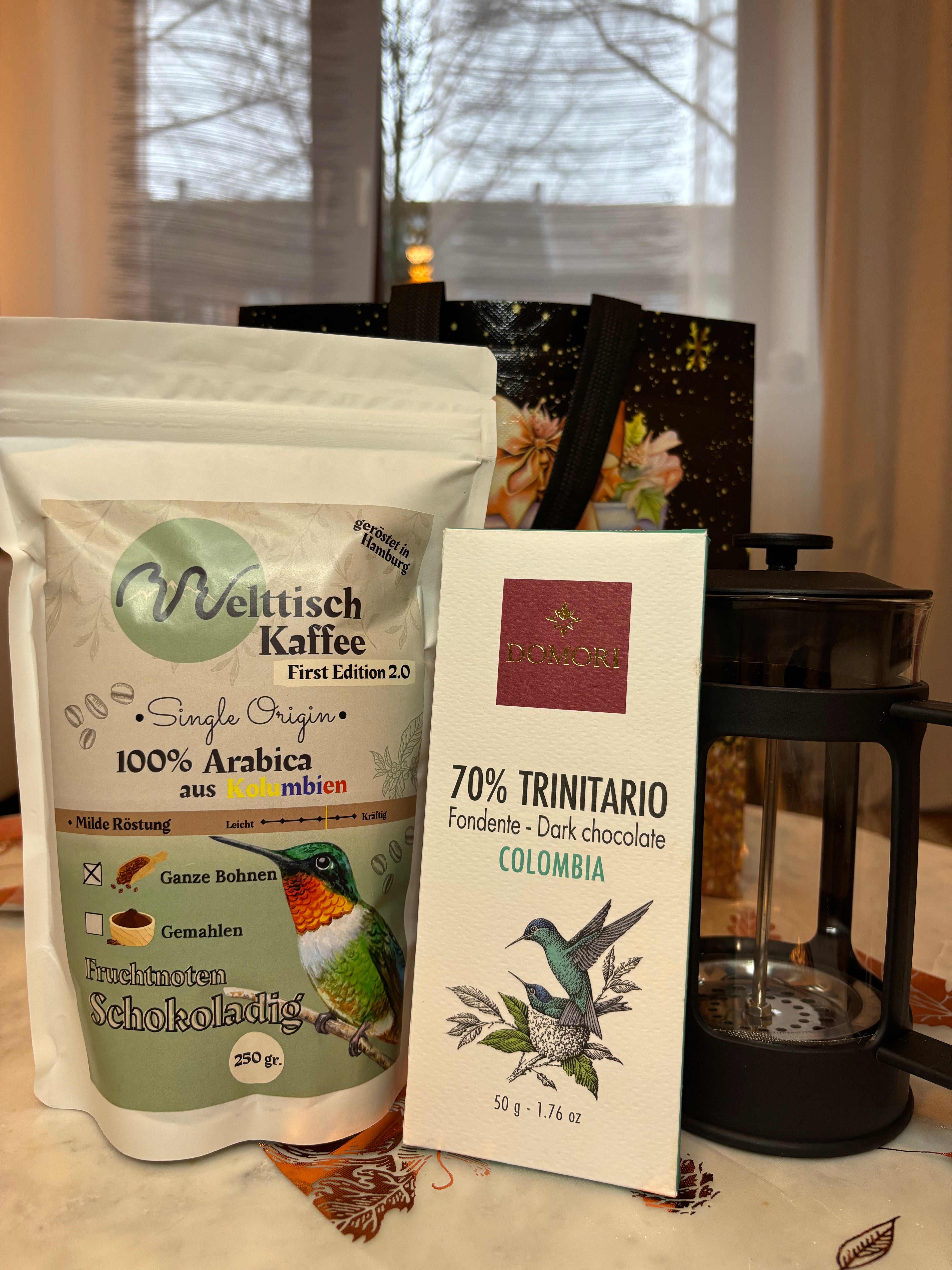
Wir empfehlen: Direkt mit einer starken Zubereitungsmethode, der "French Press". Eine unserer absoluten Lieblingsmethoden, für ein vollmundiges Kaffeeerlebnis.
Herkunft Kaffee: Kolumbien, Finca "La Mejorana"
Gelegen in der Kaffeezone, in dem Bezirk "Quindio" befindet sich die Kaffeeplantage Finca La Mejorana. Die Anbauhöhe beträgt 1.400 m ü.M.
Sorte: 100 % Arabica, Varietät Castillo
Castillo ist eine Untergattung der Coffea Arabica kolumbianischen Ursprungs. Diese ist auf vielen Fincas zu finden, wo Qualität wichtig ist. Grund ist das feine Geschmacksprofil und die erhöhte Resistenz gegen Krankheiten. Diese Resistenz ermöglicht einen nachhaltigeren Anbau durch den verminderten Einsatz von Schädlingsbekämpfung.
Aufbereitung: Washed
Bei dieser Aufbereitungsmethode wird die Kaffeekirsche vom Kern gelöst und es verbleibt eine Zuckerschicht um den Kern. Die Kerne werden mit Zugabe von Frischwasser in einem Wassertank gelagert, wo die Zuckerschicht fermentiert. Dadurch wird sie gelöst und "abgewaschen". Das führt zu einem klaren Geschmacksprofil mit komplexeren Aromen. Bei diesem Prozess wird der authentische, "ureigene" Geschmack der Kaffeebohnen der Anbauregion widergespiegelt.
Ganze Kaffeebohnen
Unseren Kaffee gibt es ungemahlen, als "ganze Kaffeebohnen". Warum?
1. gemahlener Kaffee verliert extrem schnell Aroma
2. Nur das Mahlen nach Bedarf, angepasst auf deine Zubereitungsmethode, ermöglicht die Entfaltung der Aromen in deiner Tasse.
Geschmack: feine Fruchtnoten, schokoladiger Abgang
feine Fruchtnoten sind typisch für kolumbianischen Kaffee der aufgrund der Geografie meist an hochgelegenen Berghängen angebaut wird
Couldn't load pickup availability
-
Hurry, only 20 items left in stock!

Warum lohnt es sich, die Herkunft deines Kaffees zu kennen?

Was ist so besonders an diesem Kaffee?
Die langfristige Verbindung zwischen dir, dem Konsumenten, und dem Ursprung des Kaffees, Tio Carlos auf der Finca La Mejorana, ist uns besonders wichtig. Dies ist die einzige Möglichkeit sicherzustellen, dass der Mehrwert, der auf Finca "La Mejorana" geleistet wird, wirklich bei dir ankommt und auch entsprechend gewürdigt werden kann.
Wie stellen wir diese Verbindung her? Du bekommst du von uns regelmäßig hautnahe, exklusive Einblicke in die Geschehnisse vor Ort. Einblicke in die Farm, von der dein Kaffee kommt. In die Herstellung, Ereignisse der Menschen, besondere Umweltereignisse und vieles mehr. So nah dran an der Produktion seines Kaffees, ist sonst nur der Farmer selbst!
So wird aus aus Kaffee viel mehr als nur Kaffee. Dieser Kaffee bringt den kolumbianischen Kaffeewald mit all seinen Geschmacksnoten zu dir nach Hause. Und während du den Moment genießt, trägt dieser Moment zu einer langfristig nachhaltigen Welt bei und hilfst gleichzeitig den Kaffeefarmern auf der Finca "La Mejorana"!
Qualität auf einen Blick
Mehr über den Ursprung des Kaffees und seine Merkmale:
Empfohlene Zubereitung
French Press/Kaffeebereiter:
- Mahlgrad: mittel- grob (ca. brauner Zucker Körnung)
Der Kaffee wird "naturtrüb" gebrüht und hat dadurch viel Textur und einen sehr vollen Geschmack.
Bei feinerem Mahlgrad wird der Kaffee etwas kräftiger und tendenziell bitterer, bei gröberem Mahlgrad weniger kräftig und tendenziell etwas Säurebetonter. Finde hier dein Maß je nach Vorliebe.
- Menge: ca. 6,5g pro 100 ml
- Extraktionszeit: ca. 4 Minuten
- Wassertemperatur: ca. 92 °C
Filterkaffee/Chemex:
- Mahlgrad: mittel
Der Kaffee wird stärker gefiltert und hat dadurch eine große "Klarheit" im Geschmack.
Bei feinerem Mahlgrad wird der Kaffee etwas kräftiger und tendenziell bitterer, bei gröberem Mahlgrad weniger kräftig und tendenziell etwas Säurebetonter. Finde hier dein Maß je nach Vorliebe.
- Menge: ca. 12g pro 200 ml
- Extraktionszeit: 3-5 Minuten
- Wassertemperatur: ca. 92 °C
Espresso:
- Mahlgrad: sehr fein (fast Puderzuckerartig)
- Menge: 18 g auf 40-45 ml Wasser
- Extraktionszeit ca. 30 Sekunden
- Wassertemperatur: ca. 94°C
Die Einstellungen können je nach Kaffeemaschine variieren. Oft sind es feinste Änderungen, die im Geschmack viel bewirken können. Probiere hier auf jeden Fall ein wenig aus, bis du deinen perfekten Punkt findest!
Du erkennst das daran, wenn der Kaffee eine natürliche Süße bekommt und sehr balanciert schmeckt. Weder sauer noch bitter und mit einer angenehmen Süße.
Schmeckt dir der Kaffee zu bitter, sollte das Ziel sein, ihn "schneller" durchlaufenzulassen. Dafür den Mahlgrad leicht gröber stellen.
Schmeckt dir der Espresso zu säuerlich, sollte das Ziel sein ihn etwas "langsamer" durchlaufen zu lassen. Dafür den Mahlgrad leicht feiner stellen.
Herkunft und Anbau auf der Finca "La Mejorana"
The finca has been in the hands of one family for 5 generations. The farm has always been managed in harmony with nature. The knowledge has been passed down from generation to generation. Currently, “Tio Carlos” (Uncle Carlos) runs the finca. He is on He grew up on the finca and has also learned a lot from the previous generation. He remembers his grandfather in particular with awe: "He is the wisest man I have ever met," says Carlos about his grandfather.
His philosophy is: "You have to understand the cycles. All of agriculture consists of cycles. If you understand the cycles, you can prevent problems like disease."
The cultivation method is based on one of these cycles. On the “La Mejorana” finca, the coffee is planted in an impressive forest of other trees. The many coffee plants stand in the shade of the “Nogales Cafeteros”, which are over 30 m high. The ground is covered by a thick green carpet. Weeds. A little surprising at first.

This is not an everyday occurrence on other fincas in the region. We asked ourselves the question: WHY?
There is a widespread belief that coffee plants must be kept free of other plants in order to maximize production, so that the other plants do not compete with the coffee plants for sunlight and nutrients in the soil.
For this reason, the field is often kept under control with weed killers for time reasons. Not so on the “La Mejorana” finca.
Back to the cycles: Tio Carlos is firmly convinced that his trees provide the coffee with nutrients and do not compete with them. The much larger trees have much deeper roots. They can bring up the nutrients hidden deep in the soil. When the leaves and branches fall from the trees, they are left lying there. They form a carpet of natural fertilizer, fresh nutrients for the coffee plants.
And practice proves him right. No fertilizer has been used here for years and yet the coffee plants are full of juice and fruit:

And so the green carpet ensures that the floor is not directly exposed to sunlight.
From healthy soil, you can harvest healthy coffee cherries. The circle is complete.
No competition and a win-win situation for the entire ecosystem.
Anyone who puts so much effort into the cultivation, right down to the smallest details, doesn't want to risk the result when it comes to harvesting. That's why the coffee here is picked exclusively by hand.
The result:
Only the best and really ripe cherries are harvested.

Since all the cherries on each tree ripen at different rates over a longer period of time, this involves a lot of work. The trees are walked through every day to ensure that only the really ripe cherries are harvested. This happens countless times throughout the entire harvest period.
The fresh harvest is also prepared daily according to a well-kept family recipe, using the “washed process”.
The result is a high-quality green coffee with the typical Colombian fruity notes.
Röstung: Frisch und traditionell
One of the most important steps on the way from the coffee cherry to the coffee. And therefore a step that we want to pay special attention to. And good things take time.
Our motto “Away from mass production and towards sustainable & artisanal production” is perfectly implemented in the drum roasting process.

In this traditional process, relatively small amounts of coffee are roasted for a long time at relatively low temperatures. This makes it a particularly gentle process. The beans are not only roasted dark on the outside and left raw on the inside. Instead, they are slowly cooked through from the outside to the inside.
This is significantly more complex and less productive than industrial processes, but it has three major advantages:
1. The taste:
The long roasting time means that the beans are roasted evenly and completely. This allows the aromas to develop much more strongly and the complexity is brought out better. This greatly improves the taste.
2. Tolerability.
The long roasting time allows any harmful acids contained in the coffee to be broken down. Chlorogenic acid in coffee is a spoilsport for many people, as it causes stomach problems. Fortunately, this is eliminated in the drum roaster. The coffee is therefore particularly well tolerated, especially by people who are sensitive to chlorogenic acid.
3. Health:
Coffee sometimes has a bad reputation for being bad for your health.
One reason for this is the formation of undesirable by-products during roasting, such as acrylamide . The exact effect has not been researched, but studies have shown that the substance can be carcinogenic.
Gentle roasting at low heat minimizes the formation of such undesirable byproducts.
So you can sit back and really enjoy the coffee.
This coffee is freshly roasted in Hamburg so that the best possible taste reaches your cup.
Mehr über Welttisch erfahren?


Express yourself with
#welttisch